Landlord and Tenant - CPLEA

Landlord and Tenant Information for Albertans

  • About
    • About CPLEA and Disclaimer
    • Copyright Statement
  • Topics
    • Legislation
    • Leases and Agreements
    • Security Deposits
    • Inspection Reports
    • Responsibilities
    • Shared Accommodation
    • Repairs
    • Notices
      • Eviction Notice (Notice of Termination of Tenancy for Substantial Breach)
      • Notice of Objection to an Eviction Notice
      • Notice of Entry by the Landlord
      • Notice of Landlord
      • Notice of Rent Increase
      • Notice of Termination of a Periodic Tenancy for Allowable Reasons
      • Notice to End a Periodic Tenancy
      • Tenant’s 14 Day Notice to Terminate Tenancy
    • Dispute Resolution
  • Resources
  • FAQs
  • Glossary
  • Find Help
    • Forms
    • Legal Advice
    • Government & Court Services
You are here: Home / Legislation / FAQ – How do tenants know if the Residential Tenancies Act applies to their situation?

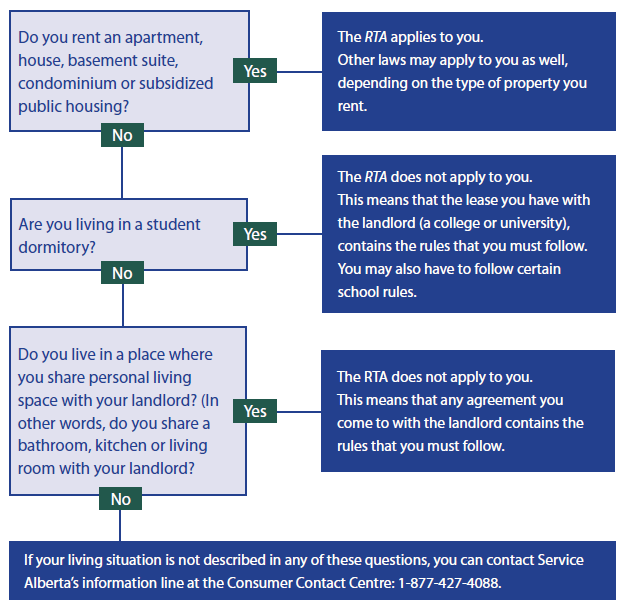
FAQ – How do tenants know if the Residential Tenancies Act applies to their situation?

The Residential Tenancies Act does not apply in the following situations:

  • tenant shares living space with the landlord. For example, the tenant rents a room in the landlord’s home and shares the kitchen with the landlord.
  • Hotel, motel, B & B, or cottage or cabin in a campground rented for less than 6 consecutive months.
  • Mobile home site.
  • Residential rental unit attached to a business and both the residence and business are rented under a single lease. For example, the tenant leases a corner store and lives in an apartment above the store. Only one lease was used to rent both the business and the home.
  • Landlord is an educational institution and the tenant is a student, and the tenant does not have exclusive possession of a self-contained dwelling unit. If the tenant lives in a university or college residence, the Residential Tenancies Act will usually not apply to them.
  • Nursing home. The Nursing Homes Act defines a nursing home as a facility that provides residents with nursing home care which includes basic services and care provided by a government-approved program. All nursing homes must meet the Long-term Care Accommodation Standards created by the Government of Alberta.
  • Seniors’ lodge. The Alberta Housing Act defines lodge accommodation as being a home for the use of senior citizens who cannot maintain their own home or do not want to live on their own.
Residential Tenancies Act Table

February 2020

Funded by

Territory Acknowledgement

The Centre for Public Legal Education respectfully acknowledges that we are located on Treaty 4, 6, 7, 8 and 10 territories, the traditional lands of First Nations, Métis, and Inuit.

A Project of

www.cplea.ca

Please note CPLEA does not provide legal advice or legal representation. For publication and resource requests, click here.

Disclaimer

This website provides legal information for Alberta law only. It does not provide legal advice. Laws may be different in other provinces.

Copyright  Legal Resource Centre of Alberta. All rights reserved. Read the full Terms of Use.

Terms of Use

  • About
    • About CPLEA and Disclaimer
    • Copyright Statement
  • Topics
    • Legislation
    • Leases and Agreements
    • Security Deposits
    • Inspection Reports
    • Responsibilities
    • Shared Accommodation
    • Repairs
    • Notices
      • Eviction Notice (Notice of Termination of Tenancy for Substantial Breach)
      • Notice of Objection to an Eviction Notice
      • Notice of Entry by the Landlord
      • Notice of Landlord
      • Notice of Rent Increase
      • Notice of Termination of a Periodic Tenancy for Allowable Reasons
      • Notice to End a Periodic Tenancy
      • Tenant’s 14 Day Notice to Terminate Tenancy
    • Dispute Resolution
  • Resources
  • FAQs
  • Glossary
  • Find Help
    • Forms
    • Legal Advice
    • Government & Court Services